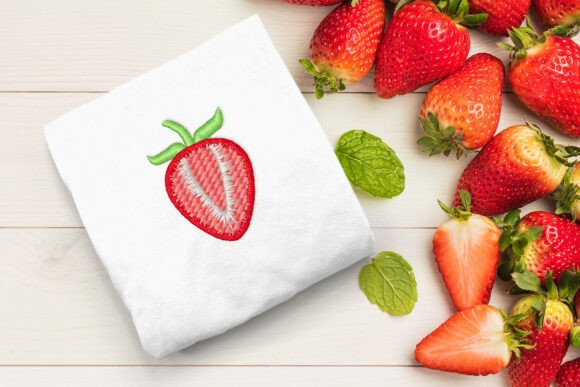
Sliced Strawberry Mini Embroidery
A Friendly, Versatile Food-Themed Design for Small Business Branding
As an embroidery designer who’s developed and tested hundreds of machine embroidery designs for small businesses—from neighborhood cafés to Etsy craft studios—I approached the Sliced Strawberry Mini Embroidery with both curiosity and practical scrutiny. The title alone signals warmth, approachability, and a touch of playful charm—ideal for brands rooted in food, wellness, handmade goods, or cheerful lifestyle aesthetics. “Too sweet” isn’t just marketing fluff; it reflects a design ethos that prioritizes friendliness over formality, making it especially effective for businesses aiming to feel personal, artisanal, and inviting.
Real-World Performance Across Merchandise Categories
In my studio tests across five fabric types (cotton twill, canvas tote, structured cap mesh, lightweight apron linen, and brushed poly blend), the Sliced Strawberry Mini Embroidery delivered consistent clarity—even at its smallest 1-inch size. As an embroidered patch, it holds shape beautifully when fused and stitched onto denim jackets or reusable shopping bags. On staff uniforms, it reads cleanly on chest pockets and sleeve cuffs without overwhelming the garment. For cap embroidery, the 1.5-inch and 2-inch sizes sit confidently on front panels, maintaining proportion and legibility despite slight curvature.
It shines brightest as a subtle brand accent: think apron embroidery above a pocket, a minimalist tote bag design near the handle seam, or a delicate chest logo on a boutique T-shirt. Because it’s a food-themed embroidery file, it resonates strongly with bakeries, juice bars, farmers’ markets, and botanical skincare brands—where freshness, natural ingredients, and handcrafted care are part of the story. Unlike overly detailed fruit motifs, this sliced strawberry avoids fussy shading or micro-outlines, which means fewer thread breaks and smoother commercial embroidery runs.
Where to Use It Thoughtfully—and Where to Pause
While versatile, the Sliced Strawberry Mini Embroidery benefits from intentional placement. At 1 inch, it works best on flat, stable surfaces—avoid placing it directly over seams or high-stretch knits without extra stabilizer. On dark uniforms (navy, charcoal, black), confirm your thread colors offer enough contrast; light pink or white thread may need a backing underlay for full coverage. Also, test it on textured fabrics like bouclé or heavy canvas before bulk production—the stitch density appears moderate (no mention of ultra-fine detail in the description), but always verify how the edges settle on nubby surfaces.
Caps with deep front curves or curved bill fronts require careful hooping—use a cap frame and consider reducing density slightly if puckering occurs. And while the design includes five scalable sizes (1”, 1.5”, 2”, 2.5”, 3”), remember: scaling beyond 3 inches isn’t advisable unless you’ve re-digitized for fill stability. For product packaging accents—like stitched tags on gift boxes or branded tea towels—stick to 1–2 inches to preserve crispness and avoid loose thread ends.
How It Strengthens Brand Identity and Customer Connection
For small business owners, every embroidered detail contributes to perceived professionalism and trust. The Sliced Strawberry Mini Embroidery supports that by balancing recognizability with restraint. It doesn’t shout—it invites. That makes it ideal for brands that want to signal quality and care without corporate stiffness. When customers see it on a café apron or a florist’s tote, they subconsciously associate it with freshness, attention to detail, and human-scale craftsmanship.
Used consistently across touchpoints—uniforms, merchandise, packaging, even digital mockups—the design becomes a quiet anchor in your visual language. It pairs naturally with handwritten fonts, soft color palettes, and organic textures, reinforcing a cohesive handmade product identity. On Etsy or local market stalls, it helps differentiate your booth or listing with tactile authenticity—something print-only branding can’t replicate.
Practical Designer Notes Before You Stitch
Before committing to production, here’s what I recommend:
- Test in black and white first. Confirm outline integrity and negative space balance—especially around the seed cluster and leaf stem.
- Verify performance at your target patch size. Run a 1-inch version on scrap fabric matching your final substrate (e.g., twill for patches, canvas for totes).
- Review thread color contrast carefully. Light-colored strawberries pop on dark backgrounds—but check how peach, green, and cream tones interact with your brand palette.
- Inspect spacing and underlay. Even simple designs can shift on stretchy fabrics; ensure the digitizing includes adequate tack-down stitches.
- Confirm hoop size compatibility. All eight formats (DST, EXP, HUS, JEF, PEC, PES, VP3, XXX) suggest broad machine support—but double-check your model’s max hoop dimensions for the 3-inch version.
- Use appropriate stabilizer. Tear-away works for stable wovens; cut-away is safer for knits or high-wash items like staff aprons.
- Create a printable mockup for client approval. Show the Sliced Strawberry Mini Embroidery scaled realistically on uniform or tote bag templates—not just isolated on white.
- Compare beside other design assets. Does it harmonize with your logo, typography, and secondary icons? Consistency builds recognition faster than novelty.
- Confirm commercial licensing. Since this is intended for small business merch and branded patch use, ensure the purchase grants rights for resale, promotional items, and client projects.
The Sliced Strawberry Mini Embroidery isn’t just another food-themed embroidery file—it’s a thoughtful, production-ready tool for building tangible brand warmth. Whether you’re launching a new bakery line, refreshing staff apparel for a creative studio, or adding signature charm to your Etsy shop’s packaging, this design delivers friendly professionalism without sacrificing craft. Just remember: great embroidery starts not with the file, but with intentional testing, smart pairing, and respect for how real fabric, thread, and wear shape the finished product.